The Quiet Career of a Loud Sign
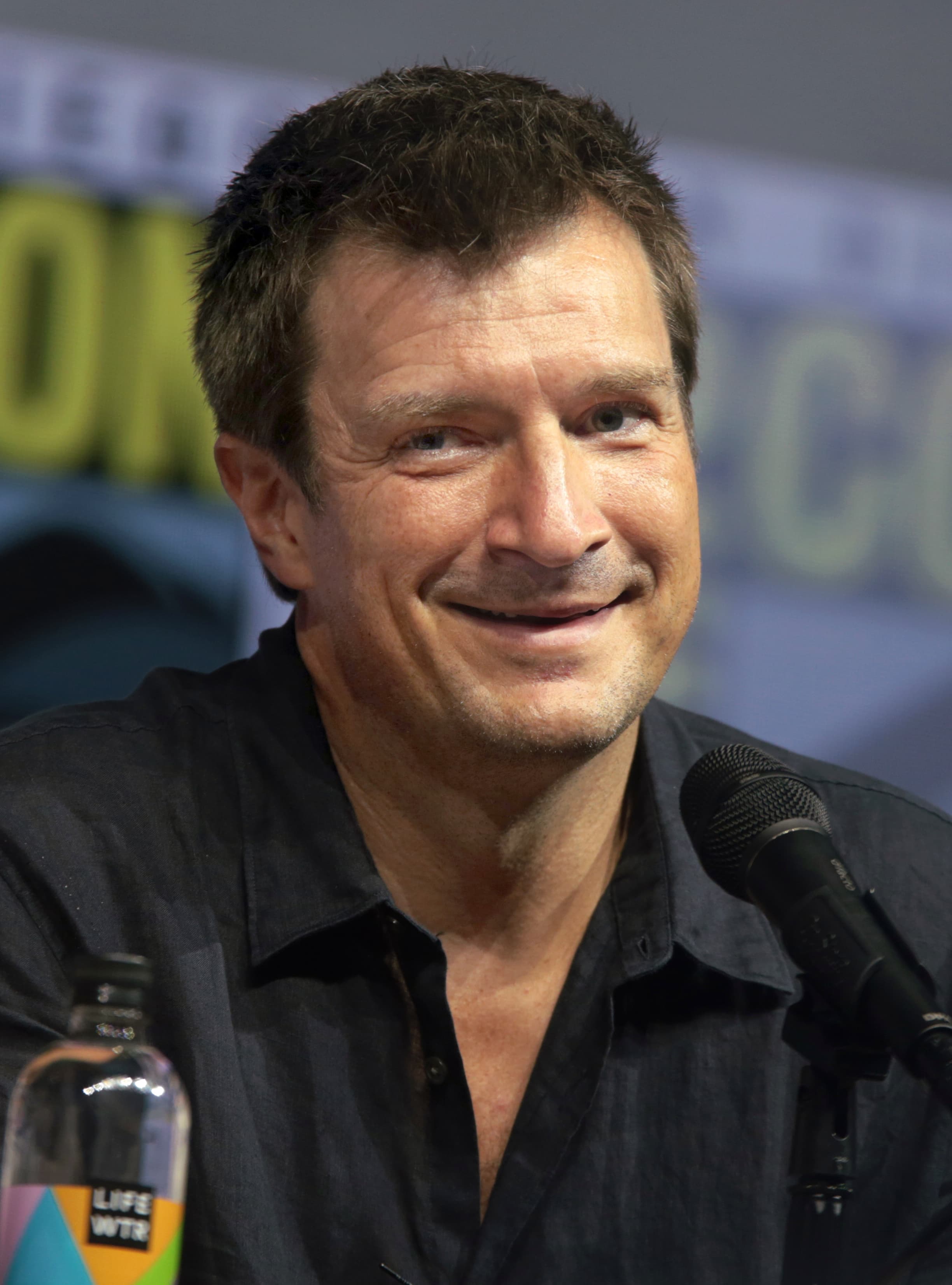
In August 2021, the city of Edmonton temporarily renamed its City Hall the Nathan Fillion Civilian Pavilion for 24 hours, after a fan petition gathered more than 27,000 signatures. The actor, who had grown up in Edmonton's Mill Woods neighborhood as the son of two English teachers, accepted the gag with the unbothered, half-grinning shrug that has become his trademark across three decades of network television. It is a small thing — a one-day civic prank — but it captures something specific about <a href="https://en.wikipedia.org/wiki/Nathan_Fillion">Nathan Fillion</a>'s public position: a person who inspires fierce, multi-decade loyalty without ever quite seeming to ask for it.
Fillion has spent more than thirty years on television. He left Edmonton for New York in 1994 for a three-year run as Joey Buchanan on the soap <a href="https://en.wikipedia.org/wiki/One_Life_to_Live">One Life to Live</a>, earned a Daytime Emmy nomination, then took the lead in <a href="https://en.wikipedia.org/wiki/Firefly_(TV_series)">Firefly</a> in 2002 — Joss Whedon's space western that Fox cancelled mid-first-season and that, somehow, accumulated one of the most durable cult fandoms of the modern television era. Eight seasons of <a href="https://en.wikipedia.org/wiki/Castle_(TV_series)">Castle</a> followed from 2009 to 2016, with four People's Choice Awards for Favorite Dramatic TV Actor along the way. He has been the lead of <a href="https://en.wikipedia.org/wiki/The_Rookie_(TV_series)">The Rookie</a> since 2018. The chart underneath all of this is what we are here to read.
The Big Two: Sun and Moon
Fillion's birth time is not publicly verified. The major astrological databases list him as Rodden Rating X — meaning no documented record exists for his time of birth. We've made an editorial decision to suppress every time-dependent claim that follows from this gap: no Rising sign, no house placements, no Midheaven readings. Anything we cannot ground in the published date itself, we leave out. What you get instead is the Big Two — Sun and Moon — both of which sit in Aries with enough degree-distance from any plausible birth-time wobble that they are reliable regardless. The Moon at 20°26' Aries on a noon estimate would still be firmly in Aries even with a twelve-hour shift in either direction; this is a stable reading.
Sun in Aries (6°27')
Fillion's Aries Sun is the cardinal-fire core of the chart — the placement that wants to start things, lead from the front, and resolve ambiguity by acting first and revising later. Concretely, this is the actor who has built a career out of playing competent men in physically dangerous situations: a starship captain, a homicide-novelist deputized into police work, a forty-something rookie cop. The Aries Sun reads forward, leans in, takes the dispatch and goes. It is not the placement that lingers on subtext.
What it costs is patience and the capacity for stillness. Aries Suns are fast, and their characteristic frustration is that other people, projects, and processes are not. Fillion has been famously generous about this — interviewers describe him as warm, self-deprecating, easy on set — but the chart suggests an internal motor that runs hot underneath the affability. The Sun also forms a tight square to Mars in Capricorn (orb 2.75°), which means the Aries-fire impulse runs into a structural-earth Mars that wants the work done correctly, on schedule, professionally. It is the configuration that produces stamina across long network-TV runs and the configuration that produces burnout if the actor cannot say no.
The complicating cross-placement worth naming is the Sun in opposition to Uranus (orb 5.29°). The Aries Sun reads as straightforward consensus-leader; the Uranus opposition wants to break form. Fillion's career has lived in this oscillation. He plays the dependable hero, but his reputation on set is for improvisation, riffing, dropping the script entirely for a moment when the moment calls for it. The opposition is the chart's argument with itself: be the captain or be the disruptor, and figure out the timing as you go.
Moon in Aries (20°26')
The Aries Moon — emotional needs in cardinal fire — is unusual when paired with an Aries Sun, because there is no internal contradiction between what Fillion wants to do and how he feels about doing it. The Sun and Moon are not arguing. The Moon at 20° Aries is hotter, more reactive, and a touch more impatient than the Sun at 6° Aries; emotionally, this is a person whose first instinct in any uncomfortable feeling is to move, fix, deflect with humor, and keep going. <a href="/celebrities/lady-gaga">Lady Gaga's Aries Sun and Aries Moon</a> shows the same fast-emotional architecture wired into a different career — performance art rather than network television — but the underlying mechanism is shared: feelings get processed through action.
What the Aries Moon costs is the patience required to sit with sadness, ambiguity, or someone else's slower emotional process. It demands movement when stillness might serve better. Fillion's well-documented humility — the self-deprecating fan-convention persona, the willingness to be the punchline of his own joke — reads as one of the chart's healthier compensations: an emotional life that uses humor as a release valve rather than letting the heat build up.
The complicating cross-placement is the Moon's conjunction with Mercury in Aries (orb 3.93°). Feelings and thinking arrive at the same moment, in the same fire-sign mode, and the Moon-Mercury merger produces someone who tells you exactly what they're feeling because they have not separated the two faculties. This can land as refreshing candor or as a person who has spoken before they've considered the temperature of the room. With Mercury at 24° Aries, the chart argues fast and direct — and the Moon, sitting four degrees behind Mercury in the same sign, gives that directness an emotional charge.
Personal Planets: Mercury, Venus, Mars
Mercury in Aries (24°21')
Mercury in Aries is the placement of the punchy, declarative speaker. It thinks in headlines, lands the joke first and explains it later if asked, and has very little patience for the kind of communication that buries the lede. Fillion's interview style — the rapid timing, the willingness to interrupt himself with a better thought — is recognizably this Mercury. So is the comedy of his Captain Hammer in <a href="https://en.wikipedia.org/wiki/Dr._Horrible%27s_Sing-Along_Blog">Dr. Horrible's Sing-Along Blog</a> (2008), a role built almost entirely on declarative-tense bravado delivered without irony, which is the Aries-Mercury joke working at full strength.
Mercury here also forms a sextile to Venus in Aquarius (orb 3.5°) — the easy-flow angle between thinking and relating. It suggests a communication style that connects with people through wit and observation rather than through emotional confession. <a href="/blog/jim-parsons-birth-chart-titanique-broadway-2026">Jim Parsons's Aries Sun</a> and verbal-comic timing read on a similar wavelength, though Parsons's Pisces Mercury softens the delivery in ways Fillion's Aries Mercury does not.
Venus in Aquarius (27°52')
Venus in Aquarius is the friend-zone Venus — affectionate, loyal, slightly detached, more comfortable with chosen-family bonds than with the conventions of romantic intensity. It produces relationships that read as partnerships among equals and, in performance, the kind of romantic lead who plays "baffled and charmed" rather than "swept away." Fillion's nine-season chemistry with Stana Katic on Castle is largely this Venus at work: a will-they-won't-they written as banter between two people who keep accidentally proving they're better in each other's company than apart.
The placement also tends toward independence as a relationship value. Venus at 27° Aquarius is late-degree, near the cusp of Pisces, which suggests a Venus that has done its Aquarian apprenticeship in detachment and learned to value depth — but the core remains air, friendship-first, and resistant to anything that would compromise the autonomy of either party.
Mars in Capricorn (9°12')
Mars in Capricorn is the chart's load-bearing column. Mars is exalted in Capricorn — meaning it operates at maximum effectiveness in this sign — and in Fillion's chart it explains everything the Aries placements cannot. The Aries planets want to start; Capricorn Mars wants to finish, on schedule, with the structural integrity intact. This is the placement that delivers eight seasons of Castle without missing a beat, that has now anchored seven seasons of The Rookie, that performs voice work for the Halo franchise (Sergeant Buck across multiple installments) and shows up the next morning to the day job.
The Mars-Capricorn ambition is patient, hierarchical, and more interested in long-term structural position than in the next big swing. It pairs with the Aries fire to produce a career that looks, from the outside, deceptively easy — but that has actually been built one professional commitment at a time over thirty-plus years.
Where the Chart Pushes Back
This is the section where flattery stops. Fillion's chart contains three hard configurations that the easy-charm Big Two reading does not capture, and each of them exacts a real cost.
Sun Square Mars (orb 2.75°, applying)
The square between the Aries Sun at 6°27' and the Capricorn Mars at 9°12' is the chart's central friction. The Aries Sun wants to act on impulse; the Capricorn Mars wants to act on plan. The square produces a person whose forward motion is constantly being audited by their own work ethic — whose first instinct is to move and whose second instinct is to ask whether the move is structurally sound. The behavioral pattern is overwork: the chart's gift is generous, but the gift comes with a fight-pattern that uses ambition to grind through what charm could otherwise carry. Aries-Sun actors with a less demanding Mars can coast on the warmth; Fillion's Mars does not allow coasting. The cost is exhaustion that he is unlikely to admit publicly, because the Capricorn Mars ethic does not consider exhaustion a permissible topic.
Mars Square Chiron (orb 0.37°)
This is the chart's tightest difficult aspect, less than half a degree from exact, and it is the configuration that explains Fillion's famously self-deprecating persona. Chiron in astrology is the so-called "wounded healer" — the asteroid associated with old hurts that become teaching grounds. A Mars-Chiron square at 0.37° suggests a tight, persistent wound around the territory of drive, anger, and self-assertion: the person learns early to soften the Aries swagger, to make jokes about their own ambition, to apologize in advance for taking up space. Fillion's interview voice — the constant gentle deflection, the way he treats his own success as a happy accident he doesn't quite deserve — reads as this aspect at work. The cost is a chronic underclaiming of credit, and the inability to fully receive praise without immediately diffusing it.
Sun Opposition Uranus (orb 5.29°)
The Sun-Uranus opposition is wider than the squares but it is the configuration most visible in the career. Uranus is the planet of disruption and unconventional choice; an opposition to the identity-Sun produces oscillation between consensus-conformity and radical independence. Fillion's career arc is the literal expression: he plays the captain, the lead detective, the rookie cop — central, consensus-leader roles — but his reputation on set is for breaking script, riffing, and refusing to play the scenes the way they were written. The cost is that the Uranian instinct, ungoverned, can read as professional unreliability. The chart's solution has been to channel the Uranian energy into improvisation within structure rather than letting it pull against the structure entirely.
Notable Aspects
The chart's signature aspect — the configuration that complicates everything — is the Sun trine Jupiter at an orb of 0.03°. This is near-partile, meaning the two planets are essentially at the same exact degree of trine, and that level of tightness is unusual in any chart. Trines are the easy-flow angle, and a Sun-Jupiter trine in particular tends to manifest as a baseline of warmth, generosity, optimism, and what the older astrological literature calls "native grace" — a quality of being liked without working for it. At 0.03°, this is not a casual placement. It is the chart's gift, and it is doing real work in Fillion's public persona: the easy laugh, the way fan conventions love him, the survival of the Firefly fandom for two-plus decades on a base of goodwill the actor seems incapable of squandering.
The second pattern worth foregrounding is the Jupiter-Neptune conjunction in Sagittarius (orb 3.49°). This is a generational placement — anyone born in roughly the same window has it — but in Fillion's chart it pairs an actor with the cultural mythology of storytelling, fandom, and long-form world-building. The Firefly afterlife is unusually well-suited to this configuration: a cancelled show that became a mythos, a captain who became a fan-symbol, a generational Jupiter-Neptune conjunction made personal by the Sun-Jupiter trine that sits next to it.
The Aries stellium itself — Sun at 6°, Moon at 20°, Mercury at 24°, all three personal planets within an 18-degree arc of the same fire sign — is the chart's headline pattern. A stellium is what astrologers call a cluster of three or more planets in a single sign, and it produces a person whose temperament is heavily weighted toward that sign's mode of operating. <a href="/blog/aries-stellium-peak-mercury-mars-saturn-april-20-2026">The Aries stellium peak transit of April 19-20, 2026</a> happens to mirror, on the sky, the kind of fire-sign concentration Fillion was born under.
Career & Public Life
The astrological indicators in Fillion's chart point clearly toward a creative career: Aries Sun for leading-role energy, Mercury in Aries for performance and verbal timing, Jupiter-Neptune in Sagittarius for storytelling and fan-culture, and the Sun-Jupiter near-partile for the kind of innate likability that holds an audience over decades. <a href="/celebrities/sarah-michelle-gellar">Sarah Michelle Gellar's Aries Sun</a> shows a parallel cult-genre-television trajectory — Buffy and Firefly arrived in adjacent eras and built fandoms on the same fire-sign principle of charismatic, slightly defiant lead-character energy.
What the chart did not promise, and what the career has nonetheless produced, is institutional longevity inside the network-television system. This is where the Capricorn Mars matters more than any of the fire placements. Soap operas, cult cancellations, eight-season procedurals, and an ongoing rookie-cop drama in its eighth year — that career shape requires the Mars in Capricorn ethic of treating the work as a structural commitment rather than a creative whim. The tension worth naming is that the Aries Sun would, on its own, have produced a more volatile actor: bigger swings, shorter runs, more public reinvention. The Capricorn Mars is what holds the chart together professionally, and its cost is a career that looks less ambitious from the outside than it actually is.
Relationships
Venus in Aquarius and Mars in Capricorn produce a relational signature that reads as friendship-first, structurally serious, and resistant to performative romance. Fillion has been notably private about his personal life, which is exactly what the Capricorn Mars and the late-degree Aquarius Venus would predict — the Mars wants to keep the structural commitments private from the public-facing career, and the Venus prefers chosen-family loyalty to public declarations. The trade-off the chart sets up is that the Aries fire wants intensity, but the Aquarius Venus wants distance, and the resolution tends toward partnerships built on shared work, shared humor, and a high tolerance for autonomy on both sides. <a href="/celebrities/ewan-mcgregor">Ewan McGregor's Aries Sun</a> shows a different resolution to the same fire-sign relational temperature — McGregor's chart leans more publicly into the romantic-lead persona — which suggests the Aries Sun does not, by itself, predict relationship style. Venus and Mars do.
The Transit That Actually Matters
Of every transit on Fillion's chart in spring 2026, one outranks the rest. Saturn — the planet of structure, consequence, and earned authority — entered Aries on February 13, 2026, and will remain there until April 12, 2028. For Fillion, this means transiting Saturn is moving directly through his Aries stellium, hitting his Sun at 6°, his Moon at 20°, and his Mercury at 24° in sequence over the next two and a half years.
This is the single most significant transit in Fillion's mid-fifties. Saturn-conjunct-Sun transits force a reckoning with the public identity the person has built; Saturn-conjunct-Moon transits do the same for the emotional foundation; Saturn-conjunct-Mercury transits force a reset in how the person communicates and is communicated about. To get all three in the same two-year window is the astrological equivalent of having a structural engineer audit the entire load-bearing wall of the chart at once.
In practical terms, the transit suggests that the period 2026-2028 is the moment when Fillion's professional structure — what he says yes to, what he says no to, how he wants the next chapter of the career to be shaped — gets its first major Saturn-in-fire stress test. Saturn in Aries is not a comfortable transit for anyone with Aries placements; it slows the fire-sign tempo down, demands accountability for the impulses, and tends to produce either a more disciplined version of the person or a season of frustration with constraints. Combined with the Saturn-conjunct-Neptune feature of 2026, the transit also asks Fillion to reckon with the Jupiter-Neptune mythology in his chart — the fandom, the cult-show afterlife — and decide what of it is structurally true and what is generosity he has been giving away. It is, structurally, the most defining transit of his fifties.
What This Chart Asks You to Reckon With
The contrarian observation worth making about Fillion's chart is that the near-partile Sun-Jupiter trine, at 0.03°, is so tight that it should — by the standard astrological reading — produce someone who can coast on charm. The configuration is famously associated with native ease, popularity, and the kind of luck that arrives without obvious effort. And yet the career evidence suggests Fillion has done the opposite of coasting. He has been on television almost continuously since 1994. He took the Firefly cancellation and turned it into thirty years of fan loyalty by showing up to conventions, signing autographs, and being recognizably the same person off-camera as on. He has anchored two long-running network procedurals back-to-back.
This is what the Capricorn Mars and the Mars-Chiron square produce, and it is the chart's quiet argument with its own gift: the Sun-Jupiter trine offers ease, but the chart will not let its owner accept ease on its own terms. The Mars-Chiron square at 0.37° insists that the work is never quite finished, that the praise never quite belongs, that the next professional commitment is the one that justifies the previous one. The cost of this configuration is a career that, from the inside, probably feels more anxious than it looks. The demand is permanent diligence in a chart that the world thinks should be effortless. What it asks you to reckon with is that even the most generous astrological gifts come with a personal physics: someone has to hold the structure up, and in Fillion's chart, the Capricorn Mars has been doing that work, quietly, for thirty years.