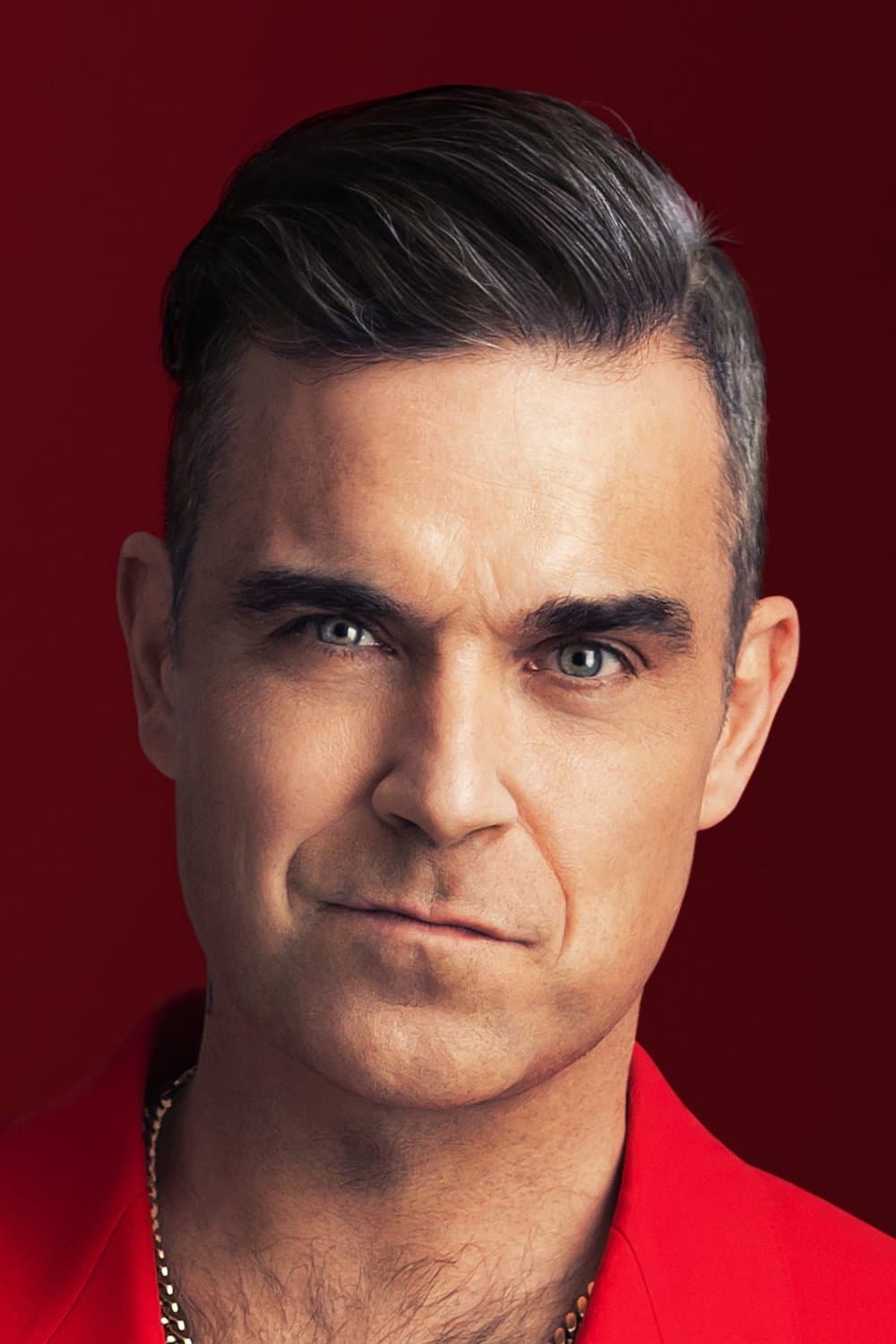
At Knebworth Park in August 2003, more than 375,000 people sang back lyrics he had written, across three nights that remain the largest music event in British history. He stood at the front of that field — small in the wide green frame of it — and did the thing he has done his whole career: turned solo exposure into a kind of collective ritual. A Stoke-on-Trent kid raised above a pub, then a teenage member of Take That from 1990 to 1995, then a solo act who would go on to outsell every other British male artist of his generation, kept telling interviewers afterward that he could not actually feel the love coming off that crowd. He could see it. He could count it. But the loop between giving and receiving had been broken somewhere earlier in life, and no amount of capacity could mend it.
That gap — between the person other people insist they are seeing and the one the performer himself meets in the mirror — is the through-line of this profile. It is also, almost embarrassingly, what the chart suggests on first read.
The Big Three — Sun, Moon, Mercury
(Birth time is unconfirmed for this chart, so this profile substitutes Mercury in Pisces for the third Big Three placement in lieu of any time-dependent reading.)
Sun in Aquarius (24°24') — performer as outsider-philosopher
An Aquarius Sun at 24 degrees is late-degree Aquarius, almost spilling into Pisces, and it shows up as a particular kind of star: the one who is in the room and observing the room at the same time. Williams' Sun sits within a twelfth of a degree of Jupiter — a conjunction so tight it is functionally a single point in the sky — and the result is a personality that expands outward by default. Conjunction, in plain terms, is what happens when two planets occupy the same patch of zodiac and effectively merge their meanings. Sun-Jupiter merged means appetite for scale, comfort on the largest available platform, and an almost reflexive instinct toward generosity of feeling on stage. You can hear it on 'Angels,' the 1997 single that became his de facto career anthem: a song designed to be sung back by people he has not met.
The cost of an Aquarius Sun fused to Jupiter is that ordinary scale stops feeling adequate. Aquarius is an air sign that thinks in concepts and distances, and Jupiter inflates whatever it touches. Together they tend toward boredom with the merely good gig, the merely platinum record, the merely happy month. Williams has been candid for two decades about depression, addiction, and the specific exhaustion of staring at numbers that look like wins on paper but feel like static. The Aquarius Sun-Jupiter wants to mean something to a lot of strangers; it does not give clear instructions about how to mean enough to oneself.
What complicates the Sun-Jupiter? Mars at 22 degrees Taurus, squaring the conjunction with a tight two-degree orb. A square — the ninety-degree angle that produces friction — between his appetite (Sun-Jupiter in Aquarius) and his body's actual pace (Mars in fixed, slow Taurus) means the spirit wants to leap and the body wants to lie down. The same configuration shows up in Karol G, another Aquarius Sun who has spoken openly about needing recovery time her schedule rarely allowed.
Moon in Scorpio (18°40') — the private operating system
A Scorpio Moon is the inner life of a person who keeps a ledger. Moons describe how someone metabolizes feeling — what soothes, what wounds, what gets remembered — and in Scorpio they remember everything. Williams' Moon at 18 degrees Scorpio sits opposite his Mars in Taurus, an opposition tight enough (3.8-degree orb) to operate as a permanent low-grade emotional weather pattern. Opposition is the 180-degree angle that produces a tug-of-war: the Scorpio Moon wants depth, secrecy, and total emotional honesty; the Taurus Mars wants comfort, stability, and not to be disturbed. The result is a private self that broods on grievances his public self has already, by all visible measures, moved past.
The cost of a Scorpio Moon on a stadium artist is that the very intensity that makes the performance feel real makes the aftermath feel unbearable. Scorpio Moons tend to recycle slights and replay conversations long after the other party has forgotten them. Williams has been transparent in his 2024 biopic Better Man about how decades-old feuds — particularly with former Take That bandmate Gary Barlow — kept emotional bandwidth occupied long past their useful life.
The complication: that same Mercury in Pisces (next block) which softens the Scorpio Moon's lawyer brain with poetic ambiguity also makes it harder to land on a final verdict about anyone, including himself. He cannot quite prosecute the case and cannot quite drop it.
Mercury in Pisces (11°22') — the lyricist, the haze
A Pisces Mercury thinks in atmospheres rather than arguments. Mercury describes how a person processes information and forms sentences, and in Pisces it tends toward image, intuition, and emotional shorthand rather than syllogism. This is the placement that explains why Williams' best songs are not arguments — they are moods. 'Angels,' 'Feel,' 'Eternity,' 'Let Me Entertain You': each builds a weather system the listener walks into rather than a story they follow.
Pisces Mercury also squares Neptune at 9 degrees Sagittarius — a tight two-degree square between the planet of thought and the planet of dissolution. Square Neptune to Mercury is the placement that produces gifted lyricists who cannot always tell whether what they wrote is brilliant or maudlin, who second-guess their best work and overrate their thinnest, who reach for substances to quiet the static. Williams' long, public struggle with addiction reads exactly as Mercury-square-Neptune reads on the page: a mind that needs a buffer between itself and the volume of its own input.
The complication this time is the Scorpio Moon above. Scorpio wants to look directly at the wound and name it; Pisces Mercury wants to make the wound into a metaphor and hand it to strangers. The two work together when the songs come out. They war with each other every other hour of the day.
Personal Planets — Venus and Mars
Venus in Capricorn (25°48')
Venus describes how a person loves and what they consider beautiful. Capricorn Venus is structural — it wants love that lasts, that earns its keep, that does not embarrass either party in front of family. Williams' Venus at 25 degrees Capricorn is the placement of someone who, after a young adulthood of public chaos, has been married to American actress Ayda Field since 2010 and has built a four-child family with her. Capricorn Venus does not romanticize the courtship phase; it romanticizes the long-haul partnership where two people have lived through enough together to make leaving more expensive than staying.
The trade-off is rigidity. Capricorn Venus has a hard time with the messy middle of relationships — the renegotiation phase, the boredom phase, the year when nothing is wrong but nothing is thrilling. It tends to either grind through (productive) or shut down (corrosive). His Venus also squares Uranus at 27 degrees Libra, a tight two-degree square that periodically demands disruption inside the very structure Capricorn built. Translation: every few years, even the best version of this relationship probably wants to blow itself up just to feel air moving. That he and Field have stayed married through it is the chart's quieter achievement.
Mars in Taurus (22°28')
Mars is energy, drive, and the body's pace. In Taurus, Mars is slow — not unmotivated, just allergic to being rushed. It is the Mars that prefers one extremely good two-hour show to four exhausting promotional events stitched together. Williams' Mars at 22 degrees Taurus, trine to Venus (the 120-degree easy-flow angle), is what gives his stage presence its physical confidence: he moves on stage like someone who knows the audience will wait for him. He does not have to convince a stadium with speed.
But Mars in Taurus, squaring Sun-Jupiter in Aquarius, also produces the famous Williams body problem: his ambitions are airy, restless, conceptual; his body is earthy, finite, and reluctant. The chart suggests — and his biography confirms — long stretches of overcommitment followed by collapse, tour cancellations, weight fluctuations widely covered in the British tabloid press, and the slow learning that Taurus Mars does not negotiate. It either gets fed and rested or it stops.
Where the Chart Pushes Back
Moon opposite Mars (orb 3.81°) — the private brawl
This is the aspect that makes the inner life loud. A Scorpio Moon opposite a Taurus Mars sets up a permanent argument between the part that wants to feel everything (Moon) and the part that wants to feel nothing in particular (Mars). It tends to manifest as someone who broods until they snap, then regrets the snap, then broods about the regret. In Williams' interviews from the early 2000s, the pattern is visible in real time: long, candid emotional disclosures followed by combative dismissals of the journalist who took them seriously. The cost is exhausting relationships with the press and a private weather system that does not give him many genuinely peaceful days off.
Mercury square Neptune (orb 1.95°) — the lyricist's tax
The same square that makes the songs work makes the diagnostic work hard. Mercury-square-Neptune muddies the line between 'I have a real grievance here' and 'I am projecting Tuesday's mood onto a person.' It also makes substances disproportionately seductive, because they offer the temporary illusion of clarity that the placement itself withholds. Williams' transparency about addiction and recovery — including a 2023 Netflix documentary — reads as long-overdue accommodation with this square rather than triumph over it. The square does not get cured; it gets managed.
Venus square Uranus (orb 1.90°) — the relational tremor
Capricorn Venus wants permanence. Libra Uranus wants disruption inside any structure it touches. Squared, they produce a relational style that builds something stable and then, every few years, jolts the foundation just to confirm the structure still holds. The cost in his earlier life was visible chaos — broken engagements, public flameouts, the famously turbulent run before the Ayda Field marriage stabilized. The cost now, presumably, is the ongoing discipline of letting the marriage absorb the Uranus shocks privately rather than performing them in interviews.
Notable Aspects
The single dominant feature of Williams' chart is the Sun-Jupiter conjunction at 24 degrees Aquarius, orb 0.12 degrees — essentially a single fused point. Conjunctions this tight are unusual; most 'conjunctions' cited in popular astrology run 3-6 degrees apart. A twelfth-of-a-degree conjunction means these two energies are not in conversation, they are the same wire. The Aquarius Sun's appetite for being seen by many people is identical to the Jupiterian appetite for scale. It is why his solo career, when it took off in 1997, did not creep upward — it lurched into stadium-size almost immediately, and has remained there for thirty years.
The complicating aspect that earns its place next to the Sun-Jupiter is Mars in Taurus squaring the conjunction with a tight orb. The same chart that promises permanent stadium-grade visibility also installs a body that cannot reliably show up to deliver it. Every Williams comeback tour, every retreat, every announcement and counter-announcement is the audible negotiation between Sun-Jupiter's reach and Mars's brake.
A secondary pattern worth naming: Saturn at 27 degrees Gemini retrograde, trine to Jupiter (orb 3.45). This is the structural aspect that has, against the odds, let Williams remain commercially viable for three decades. Saturn trine Jupiter is the discipline-and-expansion handshake that turns charismatic talent into durable career architecture. Without it, Sun-Jupiter alone would have burned the candle by 2005.
Career & Public Life
The Aquarius Sun-Jupiter is the chart's promise. The career delivers on it almost too literally. Williams joined Take That at sixteen in 1990, became the band's reluctant comic foil, left under acrimonious circumstances in 1995, and was widely expected to flame out. Instead, his 1997 solo debut Life thru a Lens launched the most commercially dominant British male solo career of the next decade — a trajectory that, by the time of the 2003 Knebworth shows, had inverted the original Take That power structure entirely.
What the chart did not promise was an American breakthrough, and the career honored that omission. Williams' attempts to crack the United States in the early 2000s — the 2002 Cirque du Soleil-flavored MTV appearances, the lavish marketing spend, the year of relocating to Los Angeles — produced, by his own scale, modest results. The Aquarius Sun's affinity is for the conceptual, the witty, the slightly distanced — a sensibility British audiences and continental European ones (especially in Germany, where he tours like a domestic act) read as endearing and American radio largely did not. His Aquarius Sun lands differently in different markets than someone like Harry Styles, whose chart configuration translates more cleanly into American pop idiom. The chart did not make him fail in the United States. It described the kind of artist whose appeal does not travel intact through that particular cultural filter.
His career second act — the Take That reunion appearances from 2010 onward, the Netflix documentary, the Better Man biopic in which he is depicted as a CGI chimpanzee — reads as the Saturn-trine-Jupiter handshake working as intended: the structural placement that knows how to package the Sun-Jupiter back to audiences in a new wrapper every few years.
Relationships
Williams married Turkish-American actress and television personality Ayda Field in 2010, and the couple have four children. Before her, his publicly reported relationships ran the catalogue of late-1990s British tabloid drama — including, at various points, fellow musicians and television presenters covered exhaustively in the British press. The Capricorn Venus that finally chose Field reads as a placement that had to exhaust every other model before accepting that what it actually wanted was something old-fashioned: a long marriage with a partner who could absorb the Uranus jolts without leaving and without being destabilized by them.
The trade-off the chart sets up — and which Williams has discussed in interviews — is that Capricorn Venus partners tend to outgrow the relationships that were primarily built on chemistry, novelty, or fame. The placement does not romanticize its own youth. What this chart got right, finally, was matching with a partner whose own life had enough independent shape to not be flattened by the Sun-Jupiter weather system. Alice Cooper's decades-long marriage navigates similar Aquarius-Sun territory — a partnership that absorbed the performer's appetite for scale without competing with it.
The Transit That Actually Matters
Pluto entered Aquarius for the long arc in 2024, and is currently moving slowly through the early degrees of the sign. Williams' Sun-Jupiter conjunction sits at 24 degrees Aquarius — meaning Pluto's exact conjunction to the most defining feature of his chart is still about seven to eight years away, with the exact hit landing in the early 2030s. This is not a tomorrow transit. It is the slow approach of the planet of compression and rewrite toward the single fused point that has produced his public identity for thirty years.
What that approach already suggests, even in its preliminary degrees, is a multi-year renegotiation of what the Aquarius Sun-Jupiter signature is actually for. Pluto does not destroy what it touches; it strips it down to load-bearing structure and rebuilds it underneath. For Williams, that likely manifests over the rest of the decade as a quieter, more deliberate sorting of which parts of the public Robbie are essential and which were scaffolding. The 2024 biopic — in which he chose to be represented as a chimpanzee, partly to externalize how alien he feels inside his own celebrity — already reads as an early-Pluto-in-Aquarius move: dismantling the literal self-image in order to find out what is underneath.
The honest hedge is that Pluto transits do not announce themselves on a schedule. The work tends to look gradual from outside and seismic from inside. By the time Pluto makes exact conjunction to the Sun-Jupiter, the version of Williams it meets will likely be unrecognizable to fans who came in during the Knebworth era — not because he will have stopped performing, but because the relationship between the performance and the performer will have been rewritten from underneath.
What This Chart Asks You to Reckon With
The flattering reading of Williams' chart is the Sun-Jupiter in Aquarius — a born star, a generous performer, a generational voice. The honest reading is that the Sun-Jupiter is the easy part. Sun-Jupiter handed him a stadium-size talent and a stadium-size appetite, and the rest of the chart spent thirty years figuring out how to survive it. The Scorpio Moon kept score privately of every win that did not feel like one. The Taurus Mars staged the body's permanent rebellion against the schedule the talent demanded. The Mercury-Neptune square made the songs and made the addiction. The Venus-Uranus square made the early relationships explode and the later one negotiate constant low-grade aftershocks. What this chart costs its owner is the gap between what the public sees on stage and what he meets when the lights go down — a gap the chart did not invent and cannot close, only describe. The work of Williams' second half, the chart suggests, is not bigger stages. It is letting the offstage hours stop being a tax he pays for the onstage ones. Whether Pluto's slow arrival to the Sun-Jupiter helps with that, or just rewrites the terms of the negotiation, is the open question of the decade.
Methodology
Planetary positions are calculated using the Swiss Ephemeris via Kerykeion, with sign, degree, minute, and retrograde state pulled directly from the engine output and not paraphrased. Birth time is unconfirmed, so this analysis covers sign placements and transits only. Time-dependent reading (anything keyed to the rotation of the sky at the moment of birth) is not present in this profile. Birth date and birthplace are sourced via Astro-Databank.