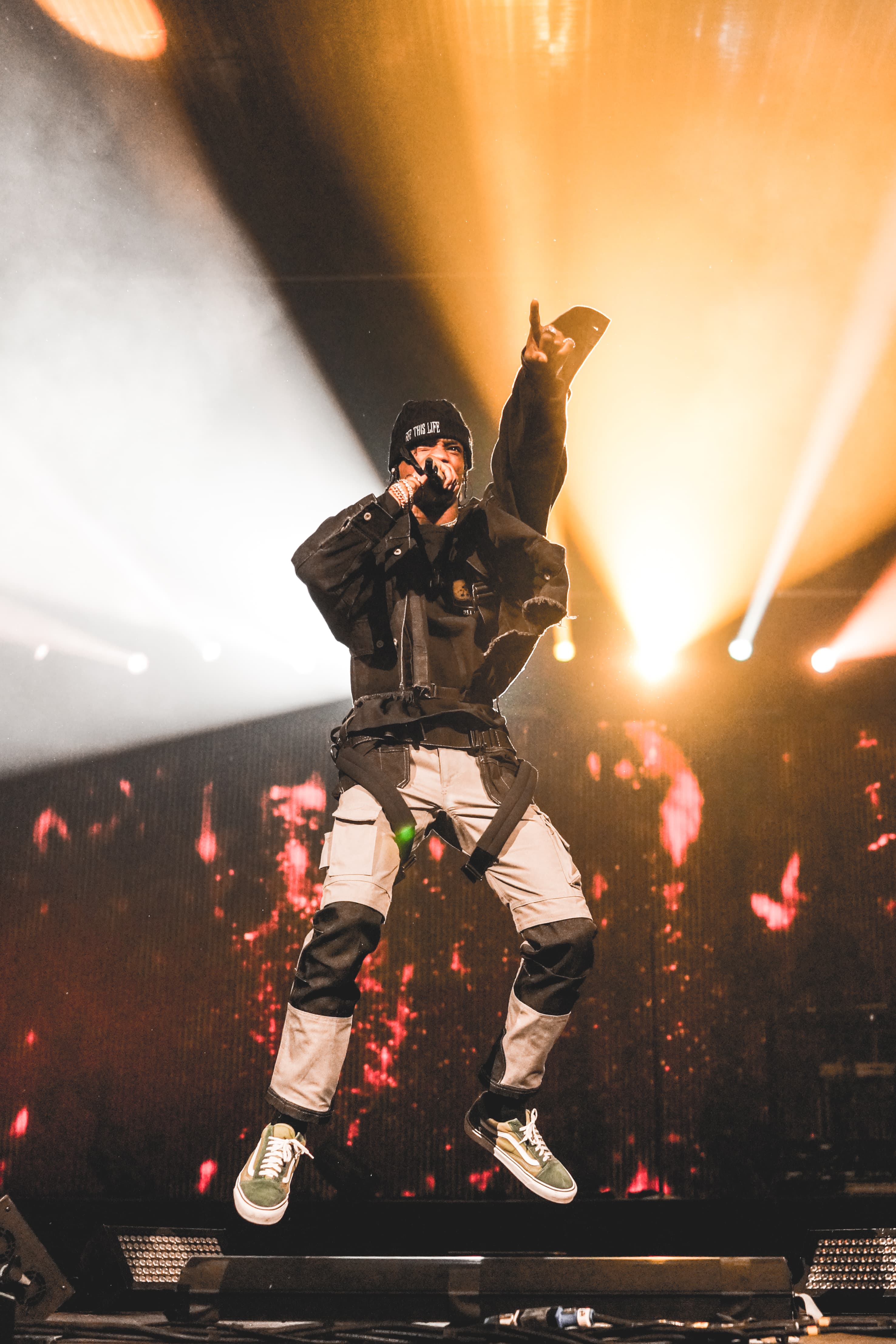
In late July 2023, a rapper from Missouri City, Texas released an album that had been teased, delayed, and re-staged for almost two years — including a scheduled concert at the Giza pyramids that Egyptian authorities ultimately cancelled. The album came out anyway, debuted at [No. 1 on the Billboard 200](https://en.wikipedia.org/wiki/Utopia_(Travis_Scott_album)) with over 496,000 album-equivalent units in its opening week, spawned the [Circus Maximus Tour](https://en.wikipedia.org/wiki/Circus_Maximus_Tour) that ran through 2023-2024, and formally ended the commercial interregnum that had followed the November 2021 Astroworld Festival crowd crush.
That's the ambition scale of a Taurus Sun with Jupiter in Leo, run by someone whose charts reads less like a stable empire and more like a planet that keeps trying to outrun itself. Jacques Bermon Webster II — better known as Travis Scott — was born in Houston on April 30, 1991. His public birth time is not documented on [Astro-Databank](https://www.astro.com/astro-databank/Scott,_Travis) or by any Rodden-rated source, which means several of the most interesting questions (Rising sign, house emphasis, the exact Moon degree) stay open. What the chart does give us, even at noon, is the engine: a five-sign spread across the personal planets, a tightly wired Jupiter-Saturn opposition, and a Mars that is simultaneously pulled by Uranus and dissolved by Neptune — a combination that produces exactly the risk appetite his career has documented.
The Big Two (and why there is no Big Three)
For most profiles we lead with Sun, Moon, and Rising — the trio that tells you who someone is, what they need, and how they arrive in a room. For Travis Scott, the Rising sign stays blank. A noon chart places it in late Cancer, but absent a verified minute of birth that is a calculation artifact, not a fact. What follows is what we can honestly say.
Taurus Sun
Taurus is the sign of the fixed earth element — stubborn, sensuous, oriented toward what can be touched, owned, and refined over time. Travis's Sun sits at 9° Taurus, and the evidence is in the ledger of physical objects he has built a second career out of: the [Cactus Jack Nike Air Jordan 1](https://en.wikipedia.org/wiki/Travis_Scott) and Jordan 4 lines that reportedly moved hundreds of millions in resale value, the [McDonald's "Travis Scott Meal"](https://en.wikipedia.org/wiki/Travis_Scott) (September 2020) that made him the first artist since Michael Jackson to get a named combo at the chain, Dior's SS22 menswear collaboration, and the "Utopia"-era merch runs that treat every tour stop as a drop.
What it costs this Sun is the appetite never lets up. A fixed-earth Sun doesn't "take the win and rest" — it builds, buys, upgrades, accumulates, and then has to defend what it has built, because the chart has no Libra diplomacy to smooth edges and no mutable escape hatch to let go. The complicating placement here is [Jupiter in Leo](/blog/venus-conjunction-uranus-taurus-april-24-2026-transit) (5° Leo, square the Taurus Sun by 4.83°) — it inflates the stage the Sun wants to quietly own, and the square means the expansion doesn't come cheap. Every commercial windfall has arrived alongside a press cycle about scale creep: bigger festivals, bigger crowds, bigger claims.
Sagittarius Moon — with a caveat
At noon CDT, Travis's Moon sits at 0°39' Sagittarius — a little over 90 minutes past the Scorpio-Sagittarius cusp. That's astrologically precarious. The Moon moves roughly 13° a day, so a birth earlier than about 10:30 AM local time would leave him with a Scorpio Moon, not a Sagittarius one. Without a verified time, both remain live possibilities — which is useful to hold, because the biographical behavior he shows in public pulls from both.
The Sagittarius Moon — the mutable fire Moon, restless, philosophical, reaching — reads in the cosmic-explorer aesthetic: the space imagery, the Astroworld-as-cosmos branding, the "La Flame" persona, a performing instinct that treats the stadium as a vessel for ecstatic excess. A Scorpio Moon would explain something different: the guardedness of his press presence, the intensity of his fan bond, the way grief and control visibly entered his work after November 2021. Either way, the Moon's emotional tether is not domestic. It is driven out.
The tension this Moon produces with the Taurus Sun is real either way: Taurus wants stability, texture, ownership. The Moon wants motion, risk, experience. The resolution the chart has modeled is to literalize the Moon's hunger as commercial product — touring, collaborating, releasing — which keeps the Sun's appetite funded and the Moon's restlessness occupied.
Why no Rising
Absent a Rodden A/AA birth record, this profile treats the Rising sign and all house placements as unknown. If a verified minute of birth surfaces, the chart will be updated.
Personal Planets: Mercury, Venus, Mars
Mercury in Aries (18° Aries)
Aries Mercury is a mind that fires in flashes — short, declarative, impatient. It hits before it plans. The adlib as a core compositional element — "it's lit," "STRAIGHT UP," the punctuating yelps — is Aries Mercury as musical texture. So is the fragmented, associative verse structure that doesn't argue or narrate so much as detonate. This Mercury also sits [square Mars by 3°](https://serenastro.com/methodology) (more on that below), which sharpens the edge: he has been [publicly combative with fans, press, and production crews](https://en.wikipedia.org/wiki/Travis_Scott) more than once, and the square is the astrological signature of speech-as-weapon before speech-as-diplomacy.
Venus in Gemini (20° Gemini)
Gemini Venus loves information, novelty, shape-shifting aesthetics — the sign of the twins turns romance into a conversation that mustn't get boring. In relationships, this placement reads as the on-again, off-again with [Kylie Jenner](/blog/kylie-jenner-birth-chart-leo-astrology-2026) from 2017 through 2023 — a partnership that produced two children and repeatedly reconstituted itself across separations. Gemini Venus does not usually "settle"; it re-approaches, which fits the documented pattern.
In aesthetic terms, Gemini Venus is why his visual universe is a magpie — anime, surrealist sculpture, Western iconography, luxury fashion, theme-park kitsch — and why "Utopia" could sonically sound like three different albums stitched together. With Uranus about to cross his Venus by transit (see below), the next two years will test whether this Venus wants reinvention or rupture.
Mars in Cancer (15° Cancer)
Mars in Cancer is traditionally called Mars in fall — the most famously uncomfortable placement for Mars, because Cancer's mood-weather doesn't give the action planet its preferred clarity. What it produces, at its best, is protective drive: fight for family, fight for the city you came from, fight for what nourishes you. The "Astroworld" album title was a direct callback to the shuttered Houston amusement park he grew up visiting, and the festival of the same name was initially framed as a homecoming. Like [Megan Thee Stallion](/celebrities/megan-thee-stallion), another Houston-born artist, Travis's Mars makes home-city loyalty a central performance. Unlike her fire-dominant chart, his Mars in water runs cooler, moodier, more inward.
The chart's hardest aspects — Mars opposition Uranus by 1.41° and Mars opposition Neptune by 1.56° — both sit on this Cancer Mars. That is the section we have to be honest about next.
Where the Chart Pushes Back
Mars opposition Uranus — 1.4° and very tight
Mars in Cancer against Uranus in Capricorn is the textbook signature of sudden rupture in the drive mechanism. Mars wants protection and momentum; Uranus wants breakthrough and release. When they oppose this tightly, the person tends to cycle between long stretches of quiet intensity and abrupt, high-stakes action — the Mars shoots first, Uranus detonates the context. In Travis's career, this looks like the willingness to escalate stagecraft past what the venue, crowd size, or safety margin could hold. The [canceled Rolling Loud New York 2019](https://en.wikipedia.org/wiki/Travis_Scott) set where he had fans climb barricades, the repeated fan-injury lawsuits, and above all the 2021 [Astroworld Festival crowd crush](https://en.wikipedia.org/wiki/Astroworld_Festival_crowd_crush) that killed ten people are the public expressions of a Mars-Uranus opposition that does not self-regulate without external structure.
The cost this aspect exacts is permanence. Uranus doesn't undo itself. What the opposition demands is that the person build the safety container the aspect refuses to supply from inside — producers, legal teams, crowd consultants, systems. The astrological work is to outsource the brakes.
Mars opposition Neptune — 1.56° and equally close
Where Uranus makes the drive erratic, Neptune makes it diffuse. Mars opposite Neptune is the classic aspect for the dreamer-athlete whose effort evaporates into vibe when it should be getting specific — and, less kindly, for substance vulnerability. In a creative career, it also produces the thing Travis is genuinely extraordinary at: atmospheric world-building. "Rodeo," "Birds in the Trap Sing McKnight," "Astroworld," and "Utopia" do not function as traditional rap records — they function as [soundscapes](/blog/usher-birth-chart-libra-astrology-2026), more mood than narrative, more vibe-architecture than flow clinic. Neptune is opposing his Mars to make the music.
The trade-off is that accountability gets blurry. Who decided what, when, in the crowd-management chain on November 5, 2021? Multiple [independent investigations](https://en.wikipedia.org/wiki/Astroworld_Festival_crowd_crush) found the question resisted a clean answer. Mars-Neptune does that — it makes the chain of causation foggy for both the artist and the people around him.
Jupiter opposition Saturn — 1.6° and the tightest major aspect in the chart
This is the tightest major aspect in the chart. Jupiter in Leo — expansion, showmanship, overreach — pulls against Saturn in Aquarius — structure, boundary, sober accounting. The tightness means this axis runs hot his entire life. Every Jupiter move (bigger tour, bigger deal, bigger claim) triggers a Saturn response (legal consequence, structural constraint, reckoning), and vice versa. Like fellow Taurus [Rory McIlroy](/celebrities/rory-mcilroy), whose chart also carries a heavy Jupiter-Saturn dialogue and who spent a decade oscillating between major-championship breakthroughs and major-championship collapses, the Jupiter-Saturn opposition is not a flaw — it is the signature of a career that is never going to be smooth.
Notable Aspects
- Sun trine Uranus, just under 4° — the aspect for the genuine sonic innovator. Every album has at least one production choice that rewrites what a stadium rap record can sound like.
- Sun square Saturn, about 3° — authority tension with a paternal tint. The square runs hot against the father complex and the "responsibility" narrative.
- Mars trine Pluto, roughly 4° — concentrated power in the drive. This is why the raw stagecraft lands when it works.
- Mercury square Neptune, under 1.5° — fuzzy communication, poetic imprecision, and a persistent gap between what he says publicly and what is verifiable.
- Moon trine Jupiter, around 4° — a generosity of feeling that funds the fan bond, regardless of which sign the Moon ultimately occupies.
The through-line: the easy aspects (the trines) enable the work; the hard aspects (the oppositions and squares) are what the work costs.
Career & Public Life
A Taurus Sun with Jupiter in Leo predicts an empire-builder who wants the empire to be gorgeous. The career fits: signed to [Kanye West's GOOD Music and Epic Records](https://en.wikipedia.org/wiki/Travis_Scott) in the early 2010s, Travis released mixtapes before debuting "Rodeo" in 2015, then executed one of the most commercially complete stadium-rap pivots of the decade. "Astroworld" (2018) produced his first No. 1 single ("Sicko Mode"). "Utopia" (2023) opened at No. 1 globally. The Cactus Jack Records label signed Don Toliver and Sheck Wes. The sneaker business became a secondary income stream on a scale that most artists never reach.
Where the chart creates the tension is that Taurus doesn't naturally like the lawsuit docket. Cancer Mars doesn't like the press cycle. Jupiter-Saturn in tight opposition doesn't permit a clean "I won and retired to Tuscany" ending. The public arc since 2021 — the criminal grand jury that declined to indict in 2023, the [civil settlements](https://en.wikipedia.org/wiki/Astroworld_Festival_crowd_crush), the return to touring in 2023 with heavier safety protocols — is exactly what a tightly wired Jupiter-Saturn opposition forces: the structure has to catch up with the expansion, or the expansion has to pause.
Relationships: Venus and Mars Don't Point the Same Direction
Gemini Venus wants stimulation, variety, conversation, shape-shifting. Cancer Mars wants family, emotional belonging, protection. The two sit in adjacent signs roughly 25° apart — close enough to interact, too far apart for a clean supportive angle — which in practice means they argue more than they cooperate.
This is the chart's relationship geometry with [Kylie Jenner](/blog/kylie-jenner-birth-chart-leo-astrology-2026): on-again, off-again across six years, [two children together](https://en.wikipedia.org/wiki/Travis_Scott) (Stormi in 2018, Aire in 2022), and a public split in early 2023. Gemini Venus kept the door open; Cancer Mars kept the family unit partially intact; neither placement wanted a traditional settlement. The trade-off of this geometry is that it does not produce one long, clearly-bounded marriage — it produces partnerships that persist in modified form.
The Transit That Actually Matters
Through mid-2026 into early 2027, transiting [Jupiter in Cancer](/blog/venus-conjunction-uranus-taurus-april-24-2026-transit) will conjoin Travis Scott's natal Mars in Cancer at 15° Cancer. Jupiter-conjunct-Mars is not a subtle transit. Its keywords are appetite, expansion of drive, amplified output — and, on the unhelpful side, overreach. For an artist whose natal Mars is already opposed by both Uranus and Neptune, Jupiter coming through tends to feel like the throttle has been stuck open.
In practice, expect the transit to produce a hyperactive six-to-nine months: a release, a tour extension, a surprise collaboration, a business launch. The chart will not generate caution of its own accord here. The question the transit actually asks is structural — who around Travis is doing the Saturn job? The tight natal Jupiter-Saturn opposition means his chart knows how to do the limits work; what it does not do is self-initiate. If the 2021-2023 period forced external Saturn on him (lawsuits, insurance requirements, safety review boards), this 2026-2027 window is where it gets tested: is the structure still in place when Jupiter shows up to push the gas?
The aesthetic read: this transit, run through a Taurus Sun, tends to produce beautiful objects. The behavioral read: it tends to produce a lot of them quickly — and the reckoning with the Astroworld-era Mars-Uranus-Neptune configuration is not done.
What This Chart Asks You to Reckon With
Travis Scott's chart is a working portrait of a specific kind of twenty-first-century creative life: the artist whose greatest strengths and greatest liabilities are the same placements, separated only by context and consequence. The Mars-Uranus opposition that makes him willing to try the stage design nobody else would attempt is the same Mars-Uranus opposition that won't self-brake at scale. The Mars-Neptune opposition that produces "Astroworld" as an atmospheric masterpiece is the same Mars-Neptune opposition that made the November 2021 chain of causation hard to pin down afterward. The Taurus Sun that builds the sneaker empire is the same Taurus Sun that cannot stop building. There is no clean version of this chart where you get the music without the risk architecture.
The contrarian read the chart enforces — against the easy takes in either direction — is that Travis Scott is neither an unambiguous villain nor an unambiguous victim of his own momentum. He is an artist whose configuration rewards the behaviors that also harm him and the people around him, unless external structure absorbs the job his own chart will not do. The honest editorial verdict is that the next decade of his career stands to be legible as a referendum on whether that external structure actually stuck. The Jupiter-Saturn opposition is too tight to predict a smooth answer either way.